When Should You Hire a CPA Instead of Using Tax Accounting Software?
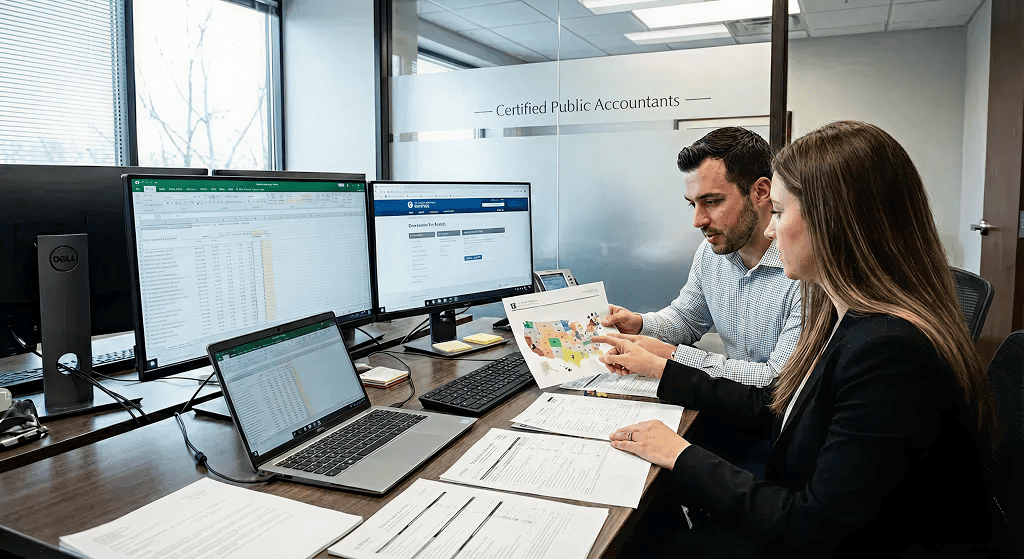
Tax filing software has made filing a personal return faster and cheaper for millions of Americans — and for straightforward situations, it does the job. But if you own a small business in New Jersey, the question isn’t whether tax filing software is capable. It’s whether it’s costing you more than you’re saving.
At Tsamutalis & Company in Upper Saddle River, NJ, we’ve reviewed hundreds of returns prepared with tax software. Here’s an honest assessment of when DIY filing makes sense, and when it’s time to call a Bergen County CPA.
When Tax Filing Software Is Probably Fine
To be fair — not everyone needs a CPA. Softwares work well for:
- W-2 employees with straightforward income
- Simple investment income (1099-DIV, 1099-INT) with no complex capital gains
- Standard deduction filers with no major life changes
- Renters without mortgage interest, charitable deductions, or business expenses
If your tax situation is genuinely simple, softwares will produce an accurate return and you’ll save money doing it yourself.
When You Should Hire a CPA: Small Business Signals
The calculus changes significantly once a business is in the picture. Here are the clearest signals that you’ve outgrown a tax filing software:
1. You Own a Small Business or Are Self-Employed
The moment you have Schedule C income, you’re dealing with self-employment taxes, business deductions, home office rules, vehicle expense calculations, and quarterly estimated payments. Software can frequently handle a Schedule C — but it asks you questions. A CPA asks better questions. The difference is often thousands of dollars in missed deductions.
2. You Have Employees or Run Payroll
If you have W-2 employees in New Jersey, payroll compliance alone is a full-time job. NJ payroll tax, UI contributions, SDI, FLI, quarterly filings with the NJ Division of Taxation — these are not areas where you want software walking you through it for the first time.
3. You’re Thinking About Changing Your Business Structure
S-Corp election, LLC formation, partnership restructuring — these decisions have permanent tax consequences. Software won’t tell you that the year you elect S-Corp status is one of the most complex returns you’ll ever file. A CPA will walk you through it and make sure the election is handled correctly.
4. You’ve Had a Major Business Event
Sold business assets? Took on an investor? Purchased real estate through your business? Closed or sold a business? Any of these events can produce capital gains, depreciation recapture, installment sale treatment, or passive activity rule complications that tax software is ill-equipped to optimize.
5. You’ve Received an IRS Notice or Are Under Audit
This one is non-negotiable. Software cannot represent you before the IRS. A licensed CPA in New Jersey can — and the cost of professional IRS representation is almost always less than the cost of going in unprepared.
6. You’re Behind on Tax Filings or Owe Back Taxes
Non-filed returns and back taxes owed create a compounding problem. The IRS can file a Substitute for Return (SFR) on your behalf — and it won’t include any deductions. A CPA who specializes in IRS resolution can negotiate installment agreements, Offers in Compromise, and penalty abatement. Tsamutalis & Company handles IRS resolution regularly for Northern NJ clients.
7. You Own Rental Property
Rental income, depreciation schedules, passive activity losses, 1031 exchanges — rental property is one of the most nuanced areas of the tax code. Done correctly, rental depreciation can generate significant tax savings. Done incorrectly, you’re leaving deductions on the table or triggering audits.
The True Cost of Using Software for Small Business Owners
Here’s the math that most business owners don’t run: Software typically costs roughly $130–$180. A good CPA charges more — but the question is whether the CPA pays for themselves.
Common areas where a Bergen County CPA finds savings that tax software misses:
- Retirement contributions (SEP-IRA, Solo 401(k)) that reduce NJ taxable income
- S-Corp election timing that eliminates SE tax on profit distributions
- Home office deduction properly calculated under the actual expense method
- Vehicle deductions optimized between standard mileage and actual expense method
- Health insurance premium deductions for self-employed owners
- Qualified Business Income (QBI) deduction maximized under Section 199A
A single one of these, done correctly, can easily save $2,000–$8,000 in a year. For most NJ small business owners, hiring a CPA pays for itself many times over.
What About Software With a Live Component or Other ‘CPA-Assisted’ Products?
Many companies offer versions where a tax professional reviews your return. These can be a reasonable middle ground for simple self-employed situations. However, they don’t provide proactive tax planning — which is where most of the value of a true CPA relationship comes from. A Bergen County CPA who knows your business throughout the year is fundamentally different from someone who reviews a completed return.
Tsamutalis & Company: Bergen County’s CPA Firm for Small Business Owners
Tsamutalis & Company has been serving small business owners in Bergen County and Northern NJ since 1992. Our services go well beyond tax filing:
- Tax planning and quarterly estimated payment management
- Business entity structuring and S-Corp elections
- IRS audit representation and back tax resolution
- Bookkeeping, reviews, and compilations
- CFO-level advisory services for growing businesses
- Business formation and new venture structuring
We serve clients in Upper Saddle River, Paramus, Hackensack, Ridgewood, Ramsey, Teaneck, Fort Lee, and throughout Bergen County and Northern New Jersey.
If your tax situation has grown more complex than what a software can handle, it’s time to talk to a CPA. Contact Tsamutalis & Company for a consultation — we’ll assess your situation and tell you exactly where the savings are.
Disclaimer: This content is for informational purposes only and does not constitute tax or financial advice. Consult a qualified tax professional for guidance specific to your situation.